How to distinguish Émail peint from painting on enamel
If you think émail peint and paiting on enamel are the same, this article will change your mind!
It will teach you all the secrets to distinguish between these two techniques.
Émail peint and painting on enamel are the two techniques that have most allowed fired enamel to establish itself as a pictorial technique and break away from goldsmith's art.
The paintings in émail peint, typical of Limoges, are found in the most important museums in the world such as the MET, the V&A, and the Louvre.
Download the PDF for free, or scroll below to read the article, and uncover all the insights! Italian version here.

Introduction
Distinguishing Émail peint from painting on enamel is neither a trivial nor a simple exercise, but it is very important for both an enameller and a goldsmith. When we get a commission, we must really understand what the customer wants. If we have to restore or reproduce a piece, it is important to understand what you are looking at and what you have to do.
Émail peint (painted enamel) is an advanced technique usually faced when you already know all the other enameling techniques. This technique involves using metal oxides or underglaze, transparent, opaque, and opal enamels, Limoges white, and sometimes, for the addition of some details, onglaze enamels, liquid gold, gold and silver powder. Gold and silver foils are also used.
From this list of materials, it is easy to understand that to learn this technique you need to know many other techniques and have solid enamelling foundations. In addition, enamel is mainly applied wet using a brush or a spatula without partitions, and colors must be placed side by side without mixing. It does not sound easy, does it?
At least we try to make it as easy as possible to recognize this technique. The main differences between these two techniques are:
Émail peint
Use of transparent and opaque colors
Use of white of Limoges (Grisaille) to create the lights, doing so also creates a slight relief
Opaques and transparent colors are applied with water, Limoges with essence of lavender
To create the shadows is used a metal oxide (underglaze)
As base color, it can use a dark color, a flux or also white
Sometimes you can find silver and gold foil used as base to enhance transparent enamels or as decoration (paillons)
Painting on enamel
Use with onglaze enamels that have a high percentage of metal oxides
The whole piece is on the same level
The colors are applied with oils and essences in thin layers
Shadows are created by mixing colors with black or by adding multiple layers of the same color
Opaque or opal white is usually used as a base
When silver and gold leaf is used, usually there is also the presence of transparent enamels. Therefore, it becomes a mixed technique
In both techniques you can see: Use of liquid gold, gold and silver powder without evident aesthetic differences.
How to recognize an émail peint
The dating
To distinguish work in émail peint from one in painting on enamel technique, the first thing you can look at if you have this information is the dating of the piece. The pieces before 1630 are made with émail peint. The details that on these pieces seem to be made with onglaze are often done with finely ground opaque or transparent enamels or metal oxides. When applied in very thin layers, metal oxides sink slightly into the base color, appearing glossy. In the works after 1630, especially in the more recent pieces (1800/2000), it is common to see these details made with onglaze enamels.
The skin
The skin is built in layers using Limoges white. If you have the possibility to touch the piece, you can feel different thicknesses. The surface is not flat but slightly wavy, with the lighter parts, with thicker white, slightly in relief. The skin color is given by the underlying base, for example flux, or using metal oxides or onglaze enamels in recent works.
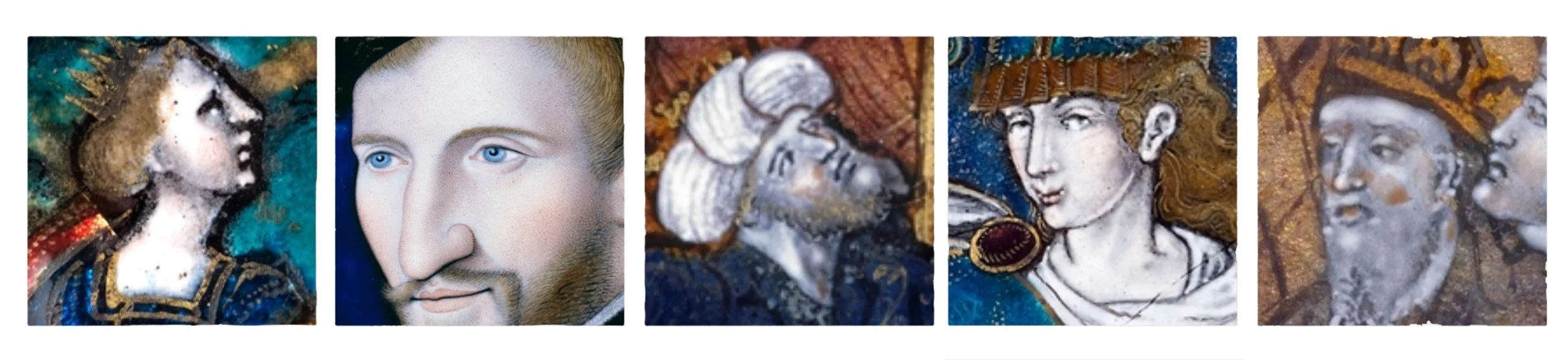
Faces painted using Limoges white.
The gold and silver foil
It is possible to see both large and small pieces of silver or gold foil. In both cases, it was usually placed under transparent colors to enhance them. It is very common to see it used in clothes, in decorations along the edge of the piece, and in contrast on a dark background.
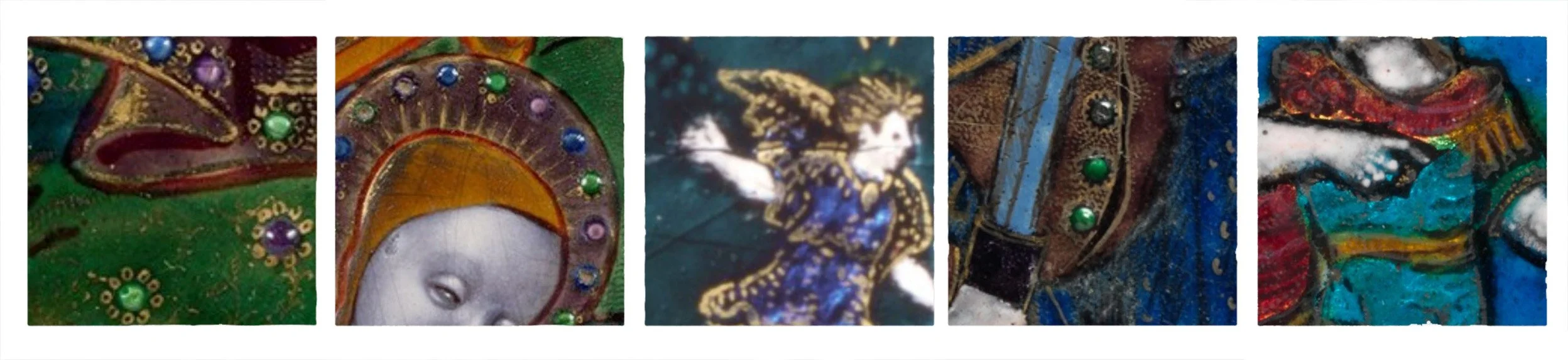
Use of gold and silver foil in émail peint.
Liquid gold and powder gold
It is very common to find details in liquid gold or powder gold that were often used to add lights, decorative elements or go over the figures' contours.
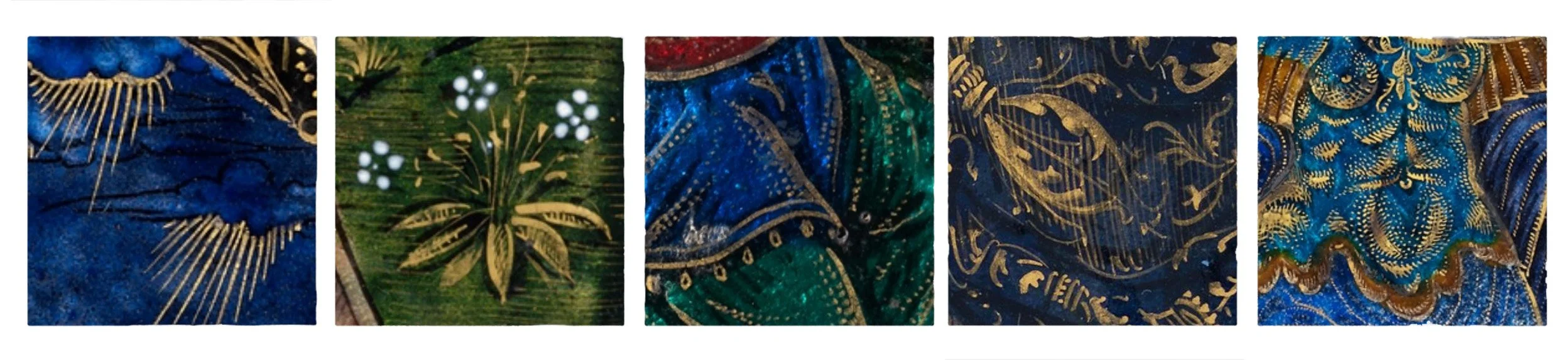
Liquid and powder gold are often used to add details in émail peint.
Shadows
One of the easiest ways to spot an émail peint is to look at the shadows and black lines under the transparent colors. These lines appear deeper because they are made above the base enamel but under the transparent ones. They are used both to outline the figures for the preparatory drawing and to give depth by creating shadows.
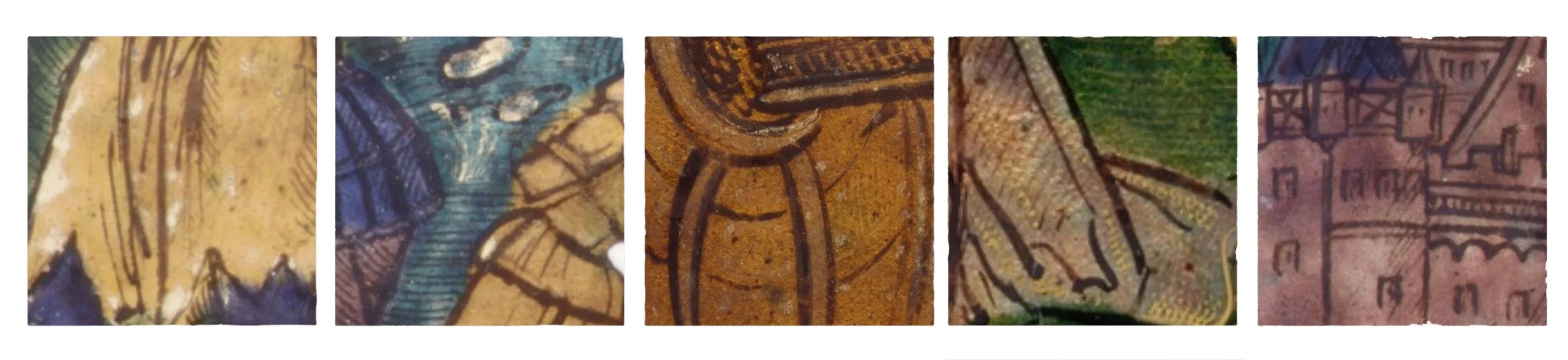
Looking at shadows is a simple way to spot an émail peint.
The white of Limoges
Limoges white can be used both above and below other enamels. It is easier to spot when used on top because it typically creates a slight relief. If you run your finger over the surface, it is very easy to notice. Alternatively, it is possible to move the piece under direct artificial light, emphasizing the hollows and the different enamel thicknesses. If it is not possible to touch the piece, for example in a museum, you can move your head to see the reflection of the light on different points of the surface. It may be helpful to look at the slightly tilted piece.
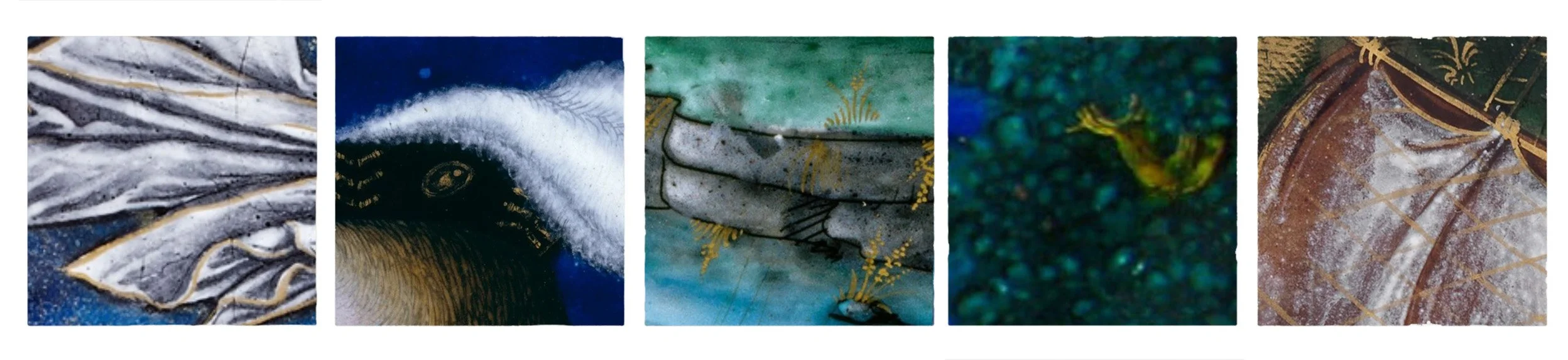
Examples of using white of Limoges in émail peint.
Sgraffito
Sometimes it is possible to find Limoges white worked with the Sgraffito technique, especially on dark colors. Once applied and dried, it is engraved with a thin point to remove some parts. This method is often used to outline the anatomical parts, clothes, or simply as a decoration or to create shadows reminiscent of an incision.
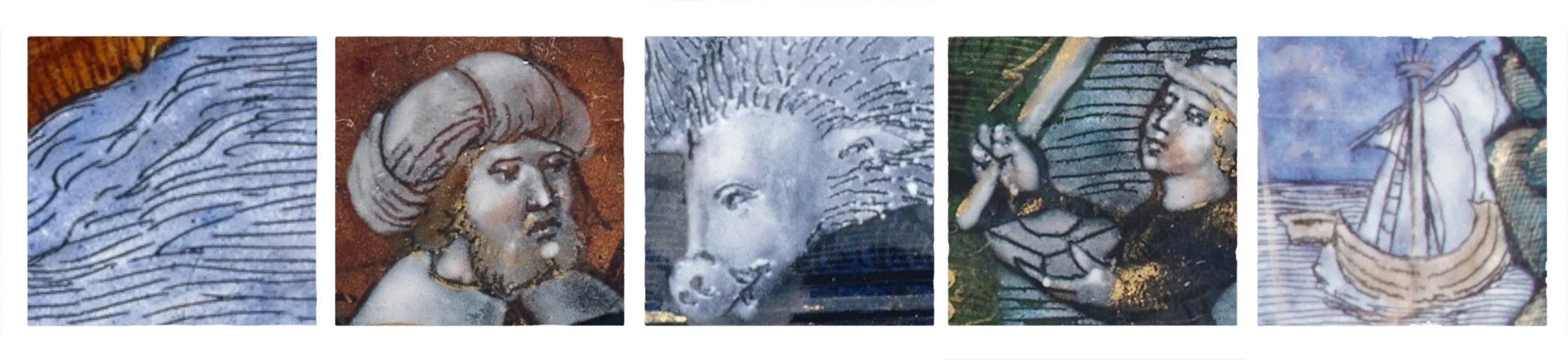
The Sgraffito technique is sometimes mixed with émail peint.
If a piece does not have these characteristics, you are likely dealing with a piece made with painting on enamel technique. However, it is important to remember that a piece in émail peint does not necessarily have all these characteristics but can only have some.
Painting on enamel
Unlike the émail peint, the painting on enamel technique is all on the same level, and the surface appears smooth, except in exceptional cases. Generally, the surface appears completely shiny, but sometimes it is possible to see less shiny brushstrokes or colors, a little chalky. These colors and brushstrokes tend to appear more superficial than the others.
Painting on enamel technique is more characterized by brushstrokes or pointillism than émail peint. The color texture is generally uniform and appears over the entire surface.
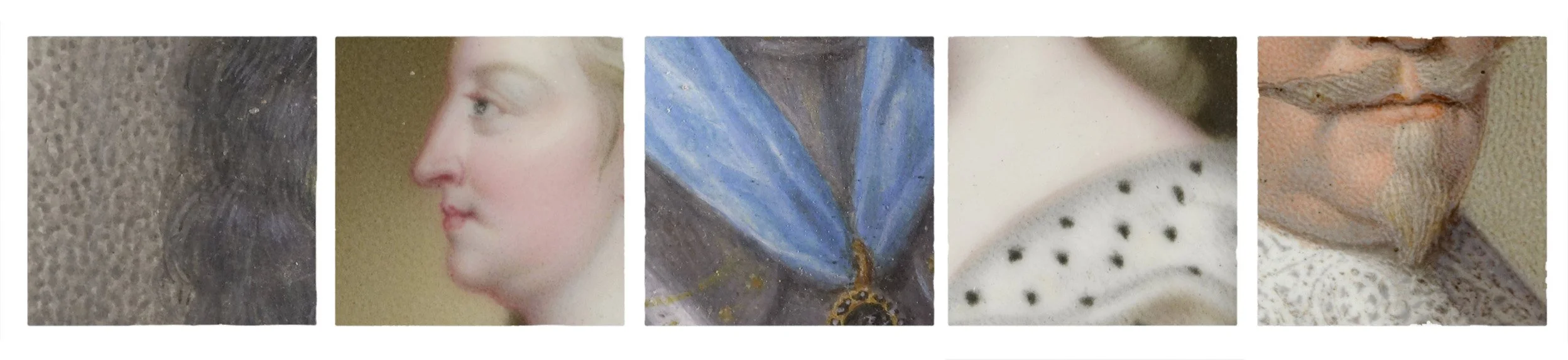
Painting on enamel has uniform textures and use of pointillism.
Conclusion
Sometimes in museums, the pieces made with the émail peint technique are called "Limoges enamel." This definition can be confusing since many different techniques have been used in Limoges throughout history.
Enamel painting, such as émail peint, can be more challenging to recognize when mixed with another technique. Over time you will learn to distinguish all the techniques present in a piece, and you will become better and better at distinguishing the émail peint from painting on enamel.
The photos in the article come from the MET and Wikimedia Commons