The History of Vitreous Enamel Art
Hot enamel is a vitreous paste similar to glass, but with particular characteristics that allow its application, by firing at high temperatures, between 700 and 900 °C approximately, on some types of metal with which it creates a stable and lasting bond over time. This art has developed over the centuries assuming the characteristics that distinguish it today.
Historically, the creation of a sort of "proto-enamel" is identified in the Egyptian and Mesopotamian civilizations, although it is erroneous to give them the credit for the actual technique. The Egyptians developed in the fourth and third millennium BC processing techniques related to glass and the world of goldsmithing, but it seems that they limited themselves to melting the glass separately and subsequently pouring it into metal cavities. In other cases the glass pastes were fixed in place by a paste similar to cement [Lopez-Ribalta and Pascual i Miró, 2010].
Thanks to this innovative process, the Egyptian civilization gave birth to jewels where gold foils were alternated with stones and glass paste encrustations, but so far it has not been convincingly demonstrated that real enamel was used for the first time in Egyptian jewels [James, 1972]. Examples of extraordinary Egyptian works are found in the treasures of the pharaohs including Tutankhamun, whose mask contains inlays of colored glass and precious stones, including lapis lazuli, quartz, and obsidian (1323 BC) [The Griffith Institute, 2021].
The Egyptian method of applying glass between gold strips subsequently evolved into enameling as we know it today. This period of evolution goes from 1500 BC to 1200 BC, which is the date assigned to the oldest enameled objects. In these finds, the glass paste was fused directly onto the base metal.
In 1952 six chiseled gold rings set with enameled platelets made with the cloisonné technique were found by Dr. G.R.H. Wright in a tomb of the Mycenaean civilization in Evreti, Kouklia, dating back to 1200 BC.
In these pioneering processes, the glass paste was not encrusted, but applied on the metal and fused directly onto the gold. By melting, the enamel went into all spaces, except for the smallest ones created between the cloisons, firmly fixing the gold cloisons in their position. These pieces were observed under the microscope and areas were found where grains of enamel of different colors are fused together while maintaining well-defined edges. This suggests that fine enamel powder was not yet used: there were fragments of enamel up to 3 mm which, once melted, trapped air bubbles between them, which emerged after stoning and polishing [Maryon, 2012; Cyprus Museum et al., 1971].
Cloisonné was the first real enamel technique, since the presence of metal partitions placed in the enamel made it possible to dampen the tensions and improved its hold. In fact, it took some time before it was possible to create enamels with optimal coefficients of expansion (COE).
These finds are followed by the royal scepter of Kourion, dating back to the Mycenaean civilization (11th century BC). It is made with polychrome enamel applied in cloisonné on a three-dimensional shape [Lopez-Ribalta and Pascual i Miró, 2010].
The treasures of Nimrud found in the palace of Assurnasirpal II (883-859 BC) in 1988-1989 date back a few centuries later, and include elaborate gold bracelets decorated with polychrome cloisonné of semi-precious stones and with parts that maybe could be real enamel. These artifacts date from the Assyrian Empire [Curtis, Collon, and Green, 1993].
In 1947 the Ziwiye hoard in Kurdistan was found, dating back to 700-600 BC. Associated with it is a gold diadem with enameled petals and chiseled gold stripes depicting animals that look like lions with blue details of an enamel-like material. Again the identification is not scientifically documented and the integrity of this hoard is suspect [Moorey, 1999]. Both the Nimrud Treasury and the Ziwiye Treasury are made of elements that are assumed to be enameled, but of which we still do not have absolute certainty. In addition, the Ziwiye hoard has been the subject of attribution disputes [1]
.In classical Greece, enameling became an integral part of jewelry from 600 BC. Phoenician navigators and travelers favored the diffusion of enameling throughout the Mediterranean. They were also responsible for the diffusion of glass technique in general. A testimony of this diffusion is the Gadir collar (6th-5th century BC) [Lopez-Ribalta and Pascual i Miró, 2010]. This technique also reached Etruscan goldsmithing [Camps-Fabrer, 1994]. An extraordinary example of this is the enameled gold earring dating back to the 6th century BC and preserved in the Met Museum.
The Celts, whose apogee of expansion in Europe dates back to 350 BC to 250 BC, were responsible for the spread of enamel and some goldsmithing techniques in the West. The attribution of this merit to the Celts is based on a third-century text by the Greek Philostratus, resident in Rome, which speaks of their ability to melt colored powders on metals. During cooling, these powders became hard and colorful [Lopez-Ribalta and Pascual i Miró, 2010].
The Celts also spread a new metal engraving technique which gave way to the development of the Champlevé, literally raised field [Lopez-Ribalta and Pascual i Miró, 2010]. This provides for the laying of enamel in cells dug into the metal through direct processing or as the product of a fusion. With this technique, in some ways similar to Cloisonné, they could create very resistant decorations for their weapons and armor.
Metalworking by engraving and the fusion technique were introduced, together with Champlevé, in the Roman Empire, in central and northern Europe when they invaded these territories [Lopez-Ribalta and Pascual i Miró, 2010]. The first artifacts were mainly made with bronze fusions enameled with opaque colors, mainly in red, blue, white, and green. The same elements are present in Celtic and Romano-British artifacts. Subsequently, thanks to Byzantine influence, the works became more accurate and complex [Speel, 1998].
The introduction of enameling had several points of origin, since in different places on the planet man developed similar or identical techniques with no apparent contact relationship between one and the other.
In the East, the oldest cradle of enamel can be identified with China, Yuan dynasty, 1280-1368 [Speel, 1998]. Precisely thanks to China, Egypt, or to the influence of the Mediterranean peoples, enamel spread throughout the Byzantine Empire (395-1453 AD) where it reached high technical and artistic levels [Lopez-Ribalta and Pascual i Miró, 2010].
The technique that underwent the first substantial improvements was Cloisonné on gold. The most exceptional and ancient examples can be found both in Byzantium and in Georgia where the oldest remains have been found, dating back to the 8th century [Speel, 1998; Lopez-Ribalta and Pascual i Miró, 2010].
The best-known work of Byzantine art is the Pala d'Oro conserved in the basilica of San Marco in Venice. The Pala d'Oro is made up of a gilded silver frame of a later period, Gothic style, which frames the Byzantine enamels. It is made up of 137 enameled pieces: the oldest date back to the 9th century, then to the 10th and the beginning of the 11th century. It is also decorated with more than 1300 pearls and precious stones [Speel, 1998].
After the fall of the Western Roman Empire (476 AD), metalworking and enameling techniques were improved and kept alive in the old continent thanks to the work of men at the service of the Church. Medieval enameling techniques adapted to new times, themes, and economic needs. Since precious metals were scarce in the West, gold began to be replaced with copper, which was subsequently gilded [Lopez-Ribalta and Pascual i Miró, 2010]. Important workshops preferred the use of the Champlevé technique.
Starting from 1100, the most important production center was the city of Limoges, in France, where enameled objects continued to be produced throughout the Middle Ages, in particular pyxes, chalices, urns, and similar objects. The Iberian peninsula was also able to successfully develop enameling, as did the Moselle and Rhine schools [Lopez-Ribalta and Pascual i Miró, 2010].
Subsequently, the Gothic style was created and the idea that light is a way to reach God spread. For this reason, dark, opaque enamels, typical of the Romanesque period, were abandoned in favor of transparent ones, previously used only in Byzantine works and in small quantities [Speel, 1998; Lopez-Ribalta and Pascual i Miró, 2010].
New techniques for creating glass were developed, leading to the birth of new enamels. The range of colors expanded, and transparent enamels became more common and began to be used on silver bases to enhance their beauty. They were used on precious metals above all for religious works, given the favorable economic conditions of the Church.
The 13th-14th century craftsman was able to perfect engraving and learn the art of chiseling which, combined with transparent enamel, gave life to a new technique called Basse-taille, bas-relief, a strong point of the Spanish and Sienese schools. The creation of this technique is due to the fusion of two different technological developments: the first, essentially French, consists in the relief working of the metal support plate, and the second, Byzantine, which uses transparent enamels [Callori di Vignale and Santamaria, 2015]. More precisely, the oldest object enameled in Basse-taille dates back to 1290, made by Guccio di Mannaia [Speel, 1998].
Meanwhile, exceptional works in Ronde-bosse, high relief, are being created in Paris thanks to the art of chiseling [Lopez-Ribalta and Pascual i Miró, 2010]. This technique involves applying enamel to three-dimensional objects and has had some precedents in Etruscan and Hellenistic earrings dating back to 300 BC in which the gold had been covered with white enamel [Baynes, 1911].
There was an air of change in the world of enameling: in the past enamel was subordinate to goldsmithing and the enameller did not exist as an independent entity. With the arrival of the Renaissance (1300-1600) the enamellers became autonomous and used enameling as a pictorial procedure in its own right.
We slowly pass from basse-taille enamels to actual painted enamels, émail peint [Lopez-Ribalta and Pascual i Miró, 2010], where the polychrome enamels are applied on a plate, without partitions, to create figurative paintings.
Some scholars argue that the Grisaille and painted enamel techniques were born in Limoges, others that they were initially developed by Flemish artisans for the Burgundian court around 1425-1450, by Venetian enamellers and artisans of northern Italy between 1450 and 1500, while the supremacy of the Limoges workshops was established only at the beginning of the 16th century [Speel, 1998; Tait, 2021].
In support of this dating there are some artifacts prior to those from Limousin, such as the "monkey cup" kept at the MET, made by the Dutch school for the Burgundian court and dated to 1425-1450 [Speel, 1998; The Metropolitan Museum of Art, 2021]. The latter scholars argue that grisaille was introduced in Limoges around 1530, the date on which the birth of this technique is commonly traced back [Speel, 1998]. Most of the enamellers, in fact, support the Limousin paternity of the Grisaille and émail peint techniques.
Grisaille was used to create monochrome enamels, the most classic being white on black, inspired by engravings. Some scholars argue that the semi-transparent white enamel used in grisaille, and particularly suited to creating flesh tones and adding lights to the design, is derived from Venetian glass [Speel, 1998]. Others argue that it was born in Limoges, which is why it took the name of Blanc de Limoges.
Among the great interpreters of émail peint we remember Reymond, Léonard Limosin, de Court and Penicaud [Lopez-Ribalta and Pascual i Miró, 2010; Musée du Louvre, 2019]. Also associated with the Grisaille technique is the term Camaieu, used since the mid-18th century to indicate a white Grisaille on a transparent background [Speel, 1998; Académie française, 1771].
Although this style of enamelling is very different from the past, we are not witnessing the end of enamels applied to jewels. On the other hand, the Plique-à-jour technique is further developed, which involves the use of transparent enamels applied on openwork that allow light to pass through as if it were a stained glass window. This technique has a known precedent: the Mérode cup which dates from the 1400s, made in gilded silver in Burgundy [Jackson and Jaffer, 2004].
Following the change in fashions and the decrease in customers, there was a serious decline starting from 1660, which brought enameling to the verge of disappearance [Lopez-Ribalta and Pascual i Miró, 2010]. This was able to survive thanks to painting on enamel, a technique born in 1630 by the hand of Jean I Toutin in Blois, perfect for creating very detailed miniature paintings. The first ones were characterized by a sort of "pointillism": the enameller created the nuances within the design with small brush strokes. This technique made it possible to paint in detail on gold or more rarely copper surfaces previously covered with a white enamel, mainly inspired by the engravings and etchings that circulated in Europe at that time [2]. The enamel used to create these works differed from the previous ones due to a greater presence of metal oxides, which guaranteed vivid and shiny colors even if applied in very thin layers.
Enamel painting was later perfected in England and reached its maximum splendor in the 18th century in Geneva, Switzerland, where the Genève technique was created in the 19th century. It is a derived technique which involves the application of a layer of flux over the miniature, giving it greater resistance to wear. The Genève technique was, in fact, designed for watch cases, inevitably subject to numerous shocks and in contact with harder surfaces that could scratch the enamel.
Another reason why the Genève technique was adopted is due to the different melting points that characterized the different enamels used for painting the enamel miniature. These differences forced the miniaturist enamelers to apply the harder colors first and then the softer ones such as reds and pinks. However, some enamels remained less shiny than others or did not fire properly, making them more sensitive to wear. These problems were solved by the enamellers by applying a protective flux layer [Hoyte Byrom, 2018].
In the field of watchmaking, the Guilloché technique also had ample space, which was subsequently widely used by Fabergè. Guilloché involves an engraving on silver or gold created by a guillocher machine, thought to have been born in 1500-1600 and initially used on soft materials such as ivory and wood [Rowe, 2021]. This repetitive engraving is covered with transparent colours, which create plays of light and dark. This technique can be called a modern variant of basse-taille enamel. It has been called in various ways over time including flinqué and arabesque, but it should be remembered that the original term refers to the guillocher machine.
From 1860, enamelling on iron also developed, at the service of the nascent industry and aimed at creating utility objects, advertising signs, pots, and similar items, quickly decorated thanks to the use of screen printing and decals [Lopez-Ribalta and Pascual i Miró, 2010].
During the 19th century Plique-à-jour enamel became very popular, mainly used in the production of jewellery. Among the best enamellers to use it we must remember René Lalique, who masterfully combined this technique with the typical style of Art Nouveau, which prevailed in Europe from 1860 to 1910.
Also in the 19th century, the first technical manuals and research aimed at improving the characteristics of enamels spread, which led to the creation of opalescent enamels, characterized by pearly transparencies. These enamels were widely used in the Fauré workshops, where a large number of vases with relief enamel, émail en relief, were produced around the 1920s and 1930s. This technique, born in 1920, provides for the application of enamel in thickness which can vary from a few millimeters to several centimetres.
From the 20th century in Spain, continuity was given to the French painted enamels, émail peint, of the 1500s, but with their own personality. This development occurred thanks to the Barcelona school and artists such as Miquel Soldevila. The characteristics of this school can also be seen in internationally renowned enamellers such as Francesc Vilasis, his brother Andreu Vilasis, and Montserrat Mainar [Lopez-Ribalta and Pascual i Miró, 2010].
In Italy in the same period, enamel was influenced by design, giving rise to furnishing works with particular lines enhanced by the vivid colors of the enamels. The major exponents can be identified in Paolo De Poli (1905-1996), who collaborated with Gió Ponti (1891-1979), and in Studio Del Campo, four artists from Turin, while Laurana focused on the market of bowls and large clocks, typically enameled with transparent colours.
The origins of Sgraffito as we know it today at a stylistic level are more imprecise, but it is assumed that they are linked to the 20th century and to the figures of Italian enamellers such as Giuseppe Guidi, although the concept behind this technique is older and linked to émail peint, grisaille and also to other artistic fields [Speel, 1998]. This technique involves scratching the surface of the still raw enamel to reveal the underlying metal or enamel and thus delimiting the figures and color backgrounds with clear lines.
In Italy the term Taglio molle is also used to indicate this technique when the enamel is applied directly on copper with a certain thickness and, at times, combined with a slight Champlevé as Ettore Paganini did. Today Sgraffito is masterfully used in Russia, where it has been improved, and extensively in the U.S.A. where a more simplified and modern version was developed starting in 1950 [Speel, 1998].
Also in the United States, Tiffany & Co., a company founded in 1837, had considerable importance in the field of enameling. One of the best known examples of the work of Tiffany artists is the peacock necklace from 1903-1906, characterized by a wise use of enamels and stones on gold.
While the old continent saw in all these centuries an evolution and alternation of techniques, to the point of making them coexist and without giving any of them real permanent hegemony, China and Japan were dominated by the cloisonné technique. This technique has evolved in different ways within the two states: in Japan it is called Shippo, it prefers pearly tones and is characterized by finer partitions. Here, starting from 1500-1600, multiple variations of Cloisonné have developed, each of which has a specific name. An example is the Moriage technique where the enamel is applied in relief in some parts of the design to give a sense of three-dimensionality.
In China, on the other hand, Cloisonné managed to secure a wider market thanks to industries that preferred opaque enamels and a faster application method thanks to the use of pipettes. An exception is the port city of Canton, in southern China, where the technique of painting on enamel was introduced by Europeans starting in the 1700s. Although enamel painting subsequently spread to Beijing, Canton remains the nerve center where the best production of mostly three-dimensional objects in painted enamel can be seen. These two states, despite having other marginal techniques such as Champlevé and Plique-à-jour, were made famous throughout the world by Cloisonné.
The Chinese and Japanese plique-à-jour is made with a different technique from the Western ones. Once again we start from a cloisonné, which is subsequently stripped of the internal copper core by the use of acids, to leave only the threads and the enamel in transparency. While in China today we tend to see a plique-à-jour with gilt copper threads, the Japanese one, Shōtai shippō, is characterized by much thinner threads and by precious metals, usually gold or silver. Although extraordinary and more effective, this version of plique-à-jour is more fragile, above all due to the fact that most of the time it deals with three-dimensional subjects, such as vases, bowls or small sculptures [Victoria and Albert Museum, 2021].
In Russia and Iran, enamel spread in certain respects in a similar way: there was the hegemony of a main technique, distinguished by a strong and decisive style. This meant that the Russian Finift, painting on white enamel, over time spread everywhere thanks above all to factories where mass production of enameled objects is still carried out today.
In Persia, corresponding to present-day Iran, in the Safavid era, an enamelling technique was created, mainly used for the decoration of hand-chiseled plates and vases, and known as minakari [Speel, 1998]. Basically it is a painting on white enamel, but in addition to the use of the brush it is often used to scratch the surface of the raw enamel to create some types of decoration such as in Sgraffito. The name derives from mina, feminine of the word mino, that is paradise. Mina refers to the sky blue widely used in this type of work.
The enamelling of metals from Persia spread to other countries including India where it takes the name of meenakari. Here it is applied mainly on gold and then on jewels, and it is also accompanied by the use of transparent colors and the champlevé technique. The Georgian art of cloisonné is called by a similar name: minankari. These techniques are still widely used in their countries today.
Currently, especially thanks to globalization, it is possible to work anywhere with all the techniques created over the centuries. For some of them, however, it is still necessary to use typical products of the area of origin of the technique, given the particular characteristics they require.
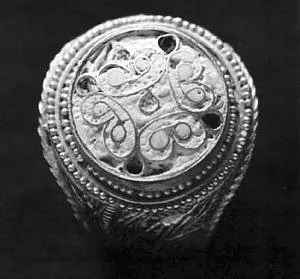
Ring found in 1952 by Dr. Wright in Kouklia. The ring, created in 1200 BC from the Mycenaean civilization, is considered the oldest example of hot enamel, and is made according to the cloisonné technique.
References
Académie française. (1771). Vocabulaire françois, ou, abrégé du Dictionnaire de l'Académie françoise, auquel on a ajouté une nomenclature géographique fort étendue. Ouvrage utile aux François, aux étrangers, & aux jeunes gens de l'un & de l'autre sexe. Regnard.
Baynes, N. H. (1911). Untitled. The Journal of Hellenic Studies, 31, 315-324. http://www.jstor.org/stable/624779
Callori di Vignale, F., & Santamaria, U. (2015). Il calice di Guccio di Mannaia: nel tesoro della Basilica di San Francesco ad Assisi: storia e restauro. Edizioni Musei Vaticani.
Camps-Fabrer, H. (1994). Valérie Gonzalez, Emaux d'al Andalus et du Maghreb. Revue des mondes musulmans et de la Méditerranée, 72(1), 123-125.
Curtis, J., Collon, D., & Green, A. (1993). British Museum excavations at Nimrud and Balawat in 1989. Iraq, 55, 1-37.
Cyprus Museum, Pieridou, A. G., & Cyprus Department of Antiquities. (1971). Jewellery in the Cyprus Museum. Republic of Cyprus, Ministry of Communications & Works, Dept. of Antiquities. https://trove.nla.gov.au/work/21499869
Griffith Institute. (2021, retrieved 2021-11-09). Tutankhamun: Anatomy of an Excavation. www.griffith.ox.ac.uk/discoveringtut
Hoyte Byrom, G. (2018). The Practice of Painting in Enamel. Self-published.
Jackson, A., & Jaffer, A. (2004). Encounters: The Meeting of Asia and Europe 1500-1800. Victoria & Albert Museum.
James, T. G. H. (1972). Gold technology in ancient Egypt. Gold Bulletin, 5(2), 38-42.
Lopez-Ribalta, N., & Pascual i Miró, E. (2010). Enameling on Metal: The Art and Craft of Enameling on Metal Explained Clearly and Precisely. B.E.S. Publishing.
Maryon, H. (2012). Metalwork and enamelling. Courier Corporation.
Metropolitan Museum of Art. (2021, retrieved 2021-11-09). Beaker with Apes. https://www.metmuseum.org/art/collection/search/470308
Moorey, P. R. S. (1999). Ancient Mesopotamian materials and industries: the archaeological evidence. Eisenbrauns.
Musée du Louvre, Département des objets d'art. (2019). Les émaux peints de Limoges. Musée du Louvre.
Rowe, P. W. (2021, retrieved 2021-11-09). Faberge Engraving Machine. https://juxtamorph.com/faberge-engraving-machine/
Speel, E. (1998). Dictionary of Enamelling: History and Techniques. Lund Humphries.
Tait, H. (2021, retrieved 2021-11-09). Enamelwork, 15th century to the present: European. Britannica. https://www.britannica.com/art/enamelwork/Western-European#ref74081
Victoria and Albert Museum. (2021, retrieved 2021-11-09). History of Cloisonné in Japan. http://www.vam.ac.uk/content/articles/h/history-of-cloisonne-enamels-in-japan-1838-1871/
British Museum object page: https://www.britishmuseum.org/collection/object/W_1964-0616-2
Article by Hans Boeckh for Patek Philippe Museum.